
When a field floods, you know first.
Solar nodes read soil moisture and standing water across every field, and text you the moment the ground turns.

Every field on a single SIM.
Nodes carry readings 340m over radio to one base station. No internet at the field edge, no subscription per sensor.

Tested in the mud, not on a bench.
A node sits in working ground at Maejo University, Chiang Mai, through an actual wet season.

Know every field without walking it.
Each node reads soil moisture and surface water on one cycle, then scores it 0–100 against that site's own wilting point and saturation.

The soil changes before the field looks any different.
By the time standing water is visible from the road, the root zone has been saturated for hours. The nodes read the ground itself, every cycle.
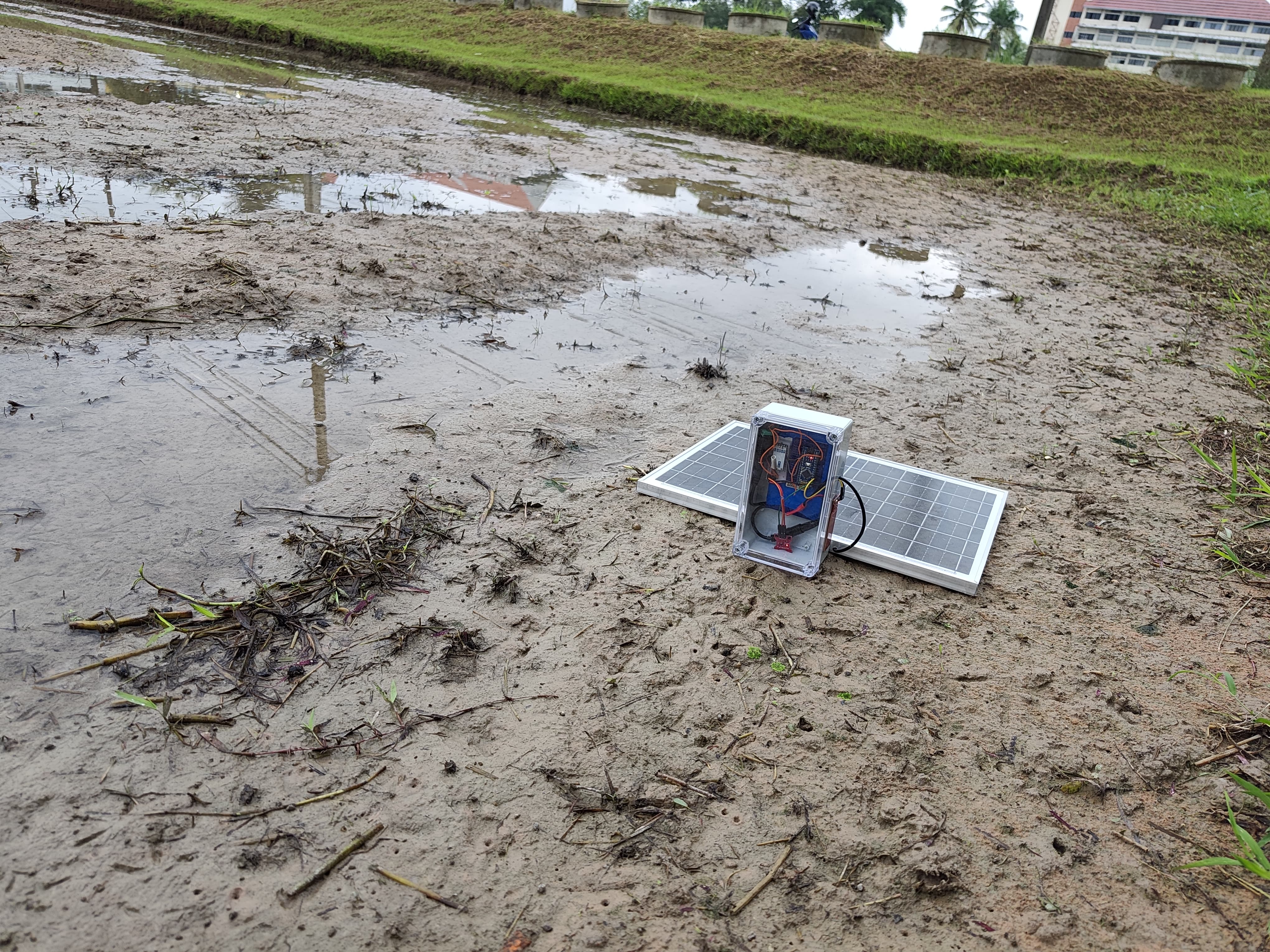
Built, sealed, and left in the field.
Thresholds are calibrated against real soil samples before any unit goes out. This is a pre-production node, in working ground.

Flood detectors represent a critical shift toward precision farming. These systems successfully achieve foundational goals like minimizing crop damage and giving operators the exact data needed to perform rapid mitigation strategies.

Get a kit in the ground.
Buy the base station once, then add a node per field. No subscription, no per-sensor SIM.
Cellular base module, one sensor node, solar for both. Launch price for the first 10 customers, then ₱8,200.
Soil and water sensor node, pairs to your existing base. ₱2,000 each for the first 10 customers, then ₱3,800.

Put one in a field.
Talk hardware, pricing, or how a pilot could work on your land.
CONTACT THE TEAM